
Events are powerful marketing tools, but they require significant investment. To justify that expenditure and secure future budgets, you need to prove their worth. That’s where event ROI (Return on Investment) comes in. It’s the ultimate metric for assessing success.
When you have always wondered how to measure event ROI in an effective manner, you are not alone. This complete guide will break down the process, from defining goals to calculating your return, and show you how to balance event budget and event ROI for maximum impact.
1. Start with Clear, Measurable Goals
It is impossible to measure success without having the idea of what success is. You need to create clear, SMART (Specific, Measurable, Achievable, Relevant, Time-bound) goals before you begin planning your event. Such objectives are what directly tell you what you will need to gather, and finally, how the ROI of an event is computed.
| Goal Category | Example SMART Goal | Metric to Measure |
| Revenue/Sales | Generate Rs 500,000 in direct sales within 60 days post-event. | Track sales attributed to event attendees or leads using unique codes/links. |
| Lead Generation | Collect 300 qualified leads (MQLs) from the event. | Scan badges, track form submissions, and qualify leads post-event. |
| Brand Awareness | Increase brand mentions on social media by 25% during the event week. | Social listening tools, unique event hashtag usage. |
| Customer Loyalty | Achieve an average event satisfaction score of 9.0/10 from attendees. | Post-event surveys, Net Promoter Score (NPS). |
2. Identify and Track Your Event Costs
Your event financing (I) in ROI is the amount you have spent on your event. During an impeccable calculation of event ROI, all expenses associated with the event must be carefully traced. This is beyond the two apparent venue and catering costs.
Direct Event Costs:
- Venue Rental: This covers space, utilities, and security.
- Catering: Food, beverage, and serving staff.
- Marketing/Promotion: Internet advertising, printed materials, email marketing programs.
- A/V & Production: lighting, screens, sound systems, videography.
- Staffing: Internal employee time, external temporary employees, and fees for speakers.
- Travel and Accommodation: To the staff members, speakers, or guests.
Indirect (Overhead) Costs:
- Technology: Subscription to event apps, registration software charges, and lead capture tools.
- Opportunity Cost: The worth of what employees would have been performing other than organizing the event (usually estimated in terms of salaries).
Through such tracking, you establish the basis of balancing event budget and event ROI. A highly-converting, small, and tightly-focused event with a low cost can, in many cases, have a significantly better ROI than a large, costly, broad-based event.
3. Determine the Monetary Value of Your Returns
This is the most difficult of the R (Return), which is mainly non-sales goals. In order to know how to measure roi on events, you have to put a dollar value on each of the good things.
Revenue-Based Returns (Direct Value)
- Sales Revenue: Sales made with the direct underlying cause of the event (i.e., contracts signed at the event, sales made by the attendees based on an event-specific discount code).
Non-Revenue Returns (Attributed Value)
In a case where things do not translate directly to an amount of dollars, such as leads or brand involvement, you should apply the standard company metrics:
- Lead Value: Divide the mean value of a qualified lead (MQL) by your conversion rates. Example: Assuming 10% of your MQLs become customers with an average customer size of 1,000, then a single MQL would be 100.
- Customer Lifetime Value (CLV): In events aimed at customer retention, the ROI is the increment in CLV with regard to a higher loyalty or lower turnover.
- Media Value: In the case of PR/Awareness objectives, approximate the cost of buying similar space in the press that you received or social media coverage.
You are able to quantify everything so that you can adequately measure the actual event roi.
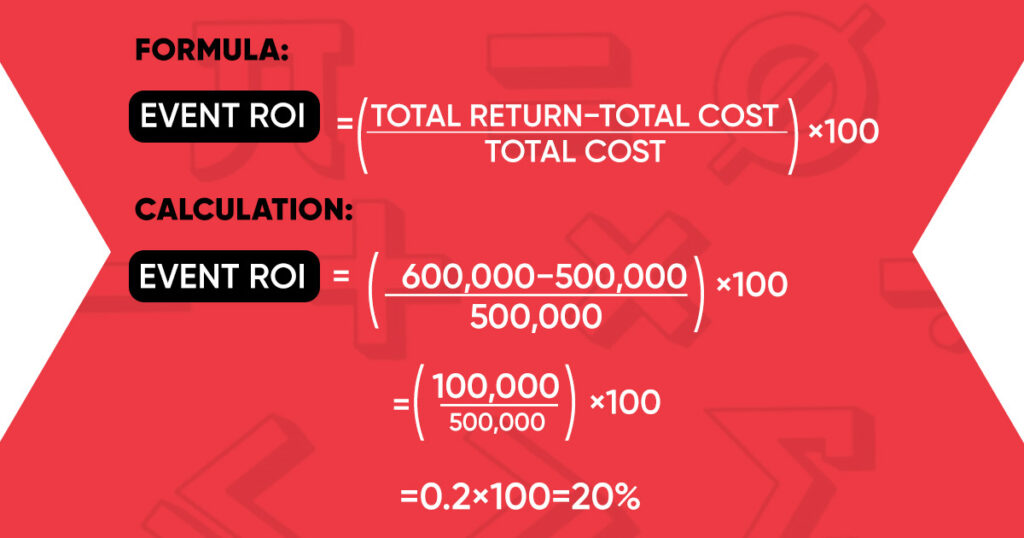
4. The Event ROI Formula: How is the ROI of an event calculated?
Total Event Cost (Investment): Rs 500,000
Total Value Generated (Return):
- Direct Sales: Rs 350,000
- Value of 50 Qualified Leads (@ Rs 5,000 per lead): Rs 250,000
Total Return = Rs 350,000 + Rs 250,000 = Rs 600,000
Sure! Here’s a complete Event ROI example in Pakistani Rupees (Rs):
Example Scenario
Total Event Cost (Investment): Rs 500,000
Total Value Generated (Return):
- Direct Sales: Rs 350,000
- Value of 50 Qualified Leads (@ Rs 5,000 per lead): Rs 250,000
Total Return = Rs 350,000 + Rs 250,000 = Rs 600,000
Result:
Event ROI = 20%
That means for every Rs 1 you spent, your event generated Rs 1.20 in return.
5. Continuous Measurement and Optimization
Measuring event ROI isn’t a one-time calculation; it’s an ongoing process.
Pre-Event (Setting Up for Success):
- Implement event-specific tracking codes, URLs, and discount codes to ensure accurate attribution.
During the Event (Data Collection):
- Use lead-scanning apps to collect contact data efficiently.
- Monitor social media engagement metrics.
Post-Event (Analysis and Follow-up):
- Integrate event data with your CRM (Customer Relationship Management) system.
- Track the progression of event-generated leads through the sales pipeline over 3, 6, and 12 months. This is crucial for accurately determining how to measure roi on events over time.
- Survey attendees and non-attendees to gauge brand perception and awareness lift.
Conclusion
When you learn how to measure event ROI, your events go from being simple costs to proven ways to grow your business. You can show that your events were financially successful if you set clear goals, carefully tracked costs, gave all returns a monetary value, and used the right formula. Focus on aligning your event spend with your strategic objectives to effectively balance event budget and event roi and continually optimize for greater returns in the future.
Ready to turn your events into powerful revenue-generating assets? Media Sniffers helps you measure, maximize, and prove your event ROI. Get in touch with us today!